Retaining Wall Permits in Bergen County, NJ
In most New Jersey towns, the answer depends on height, location, and whether the wall is holding back a slope (surcharge). And the rules can change from town to town.
This guide gives you a plain-English overview of retaining wall permit rules for:
Glen Rock, Oakland, Wyckoff, Ridgewood, Allendale, Montvale, Franklin Lakes, Paramus, Mahwah, Ramsey, and Saddle River, NJ.
Important: This page is for general information. Building & zoning codes change. Always confirm final requirements with your local building or zoning department before starting work.
Quick Rule of Thumb for Retaining Wall Permits in New Jersey
Across New Jersey, a common baseline is:
Walls under 4 feet high (measured from the bottom of the footing to the top of the wall) often need at least a zoning/sitework permit, especially if they’re near property lines.
Walls 4 feet and higher, or walls supporting a slope/driveway/building- typically require:
A construction permit under the NJ Uniform Construction Code
Often engineered drawings stamped by a licensed engineer
On top of that, local towns may have:
Maximum wall heights before you need a variance
Special setback rules from property lines
Rules for tiered walls and fences on top of walls
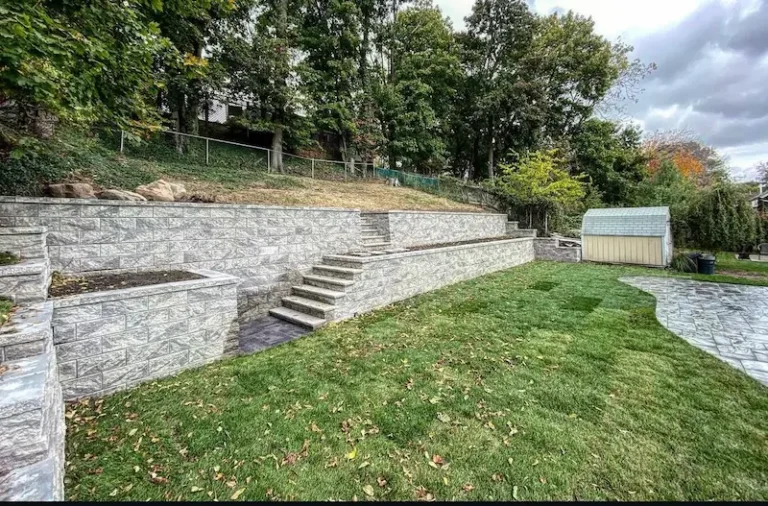
Town-by-Town Retaining Wall Permit Overview (Bergen County, NJ)
Glen Rock, NJ – Retaining Walls 4′ and Higher
Glen Rock’s sitework permit form specifically calls out retaining walls and notes that:
Retaining walls 4 ft or higher require zoning, engineering, and building permits
What this usually means for homeowners:
Small garden walls under 4 ft may only need zoning review, depending on location.
Anything at or above 4 ft will almost always need:
Engineered plans
Zoning/sitework approval
Construction (building) permit
Best move: Contact the Glen Rock Zoning/Engineering Department with your survey and proposed wall height before you dig.
Wyckoff, NJ – Zoning Application for Any New Wall
Wyckoff’s zoning rules say that before any new fence, retaining wall, or freestanding wall is erected, altered, or reconstructed, you must apply for a fence/wall zoning permit with a plot plan and wall height.
Key points:
A zoning permit is required for new retaining walls within the yard setbacks.
Depending on wall height and design, a construction permit may also be required under state code.
Best move: Assume at least a zoning permit is needed, and ask the Wyckoff Building Department whether your wall also triggers a construction permit.
Ridgewood, NJ – Setbacks & 4' Maximum Height Without Variance
Ridgewood’s zoning code specifically addresses retaining walls:
Zoning permits for retaining walls are referred to the Engineering Department for review.
The exposed face of a retaining wall must be set back from side/rear property lines at least 1 foot horizontally for every foot of wall height. Recent planning documents confirm a maximum permitted retaining wall height of 4 feet; higher walls require variance relief.
Best move:
If you’re planning a wall taller than 4 ft or close to a property line in Ridgewood, expect:
Engineering review
Possible variance
Formal construction permitting
Franklin Lakes, NJ – 4' Threshold for Building Permit
Retaining walls are listed, and a building permit is required if the wall is 4 ft or higher measured from the bottom of the footing.
Smaller walls (up to 4 ft) still fall under local zoning and fee schedules; there’s a specific zoning permit fee for retaining walls 4 ft high or less.
Best move:
Under 4 ft: Plan on a zoning permit.
4 ft and above: Plan on zoning + building permit + engineering.
Paramus, NJ – Site Work Permits & Construction Permits
Paramus requires site work permits for items like patios, walks, driveways, generators, and pool equipment.
Their fee schedule also lists retaining walls under construction permit fees, showing that they are treated as regulated work.
Most Paramus guidance (and standard NJ practice) is:
Walls under 4 ft – often a zoning/sitework permit.
Walls 4 ft and higher – construction permit under the NJ Uniform Construction Code, with engineered plans.
Best move: Check directly with the Paramus Construction Department with your wall height and location.
Waldwick, NJ – 48" Wall = Permit Required
Waldwick’s document specifically lists:
“Constructing a retaining wall that is 48” high” as work that requires a building permit.
This confirms the typical 4 ft threshold applied locally.
Best move:
Under 4 ft: At minimum, talk to the Building Department about zoning and soil movement.
4 ft and higher: Expect full permitting.
Mahwah, NJ – Setbacks Based on Wall Height
Mahwah follows NJ construction rules but also adds zoning setbacks for retaining walls:
Side/rear yard walls up to 3 ft exposed height: minimum 2 ft setback from property lines.
Walls over 3 ft exposed height: minimum 5 ft setback from side/rear lot lines.
The town also confirms that work requiring permits is governed by the NJ Uniform Construction Code.
Best move:
Even a 3–4 ft wall can trigger both setback rules and permit requirements, especially if it supports a slope.
Allendale, NJ – Construction + Possible Soil Movement Permits
Allendale follows NJ’s state rules for when construction permits are required and emphasizes that most construction work does require a permit.
They issue construction and zoning permits for work like decks, pools, and other site improvements.
Larger walls often involve soil movement, which has its own permitting process.
Best move: If you’re building a retaining wall in Allendale, especially on a slope or where soil is being cut/fill-added, plan on:
Zoning review
Construction permit for larger walls
Possible soil movement permit
Ramsey, NJ – Check Permits & Soil Movement Together
Ramsey’s code and public information highlight:
Standard construction permit process for regulated work.
A soil movement permit is required if you move more than a certain volume of soil (25 cubic yards in many cases).
While there isn’t a simple one-line “retaining wall” rule publicly spelled out, in practice:
Most structural retaining walls will need zoning and construction review, especially when:
Over 4 ft, or
Near property lines, or
Altering grade significantly
Best move: Bring your survey and proposed wall plan to Ramsey’s Building/Zoning Department and ask about both construction and soil movement permits.
Saddle River, NJ – 4' Height Limit & Minor Exemption
Saddle River’s code treats retaining walls as auxiliary structures:
Retaining walls under 12 inches in height are exempt from that specific auxiliary-structure section.
Planning documents indicate that the maximum permitted retaining wall height is 4 ft without special relief; higher walls have appeared in applications as variance requests.
Best move:
Anything beyond a tiny curb-style wall should be run through Saddle River’s Building/Zoning for proper permitting and design review.
What Inspectors in Bergen County Look for With Retaining Walls
No matter which town you’re in, Bergen County inspectors usually focus on:
Height & location
Is the wall over the 4 ft threshold?
Is it near a property line, driveway, or structure?
Engineering
Are there stamped drawings for large or load-bearing walls?
Is the wall designed for the soil conditions and surcharge?
Drainage
Proper drain stone behind the wall
Perforated pipe/drainage system to relieve hydrostatic pressure
Setbacks & safety
Distance from property lines
Guardrails or fences when there is a drop-off
Compliance with local zoning ordinances
Doing this right protects you from:
Wall failure
Drainage problems
Violations or stop-work orders
Future issues when selling the home
Ready to Start Your Retaining Wall in NJ?
Don’t guess the permit rules — let RVG handle everything.
From zoning to engineering to full construction, we build strong, long-lasting retaining walls that pass inspection the first time.
Additional Services We Offer
Plantings & Garden Enhancements
We specialize in seasonal and evergreen plantings to bring color, texture, and privacy to your landscape. From foundation planting to perennial gardens, privacy screens to ornamental trees, our planting designs are tailored to your property’s layout and light exposure. We source our plant material locally for freshness and longevity.
3D Landscape Design & Visualization
Seeing is believing. Our 3D design services allow you to visualize your entire project before a single shovel hits the ground. We build detailed digital renderings of patios, outdoor kitchens, retaining walls, fire pits, plantings, and lighting layouts—so you can approve every element with confidence and clarity.
Full-Service Outdoor Living Solutions
In addition to patios, we offer:
Outdoor kitchens and grills
Retaining and garden walls
Drainage systems and grading
Low-voltage landscape lighting
Pool patio design and coping
- Driveways
- Masonry Services
We’re proud to serve the Bergen County area with professionalism, creativity, and over 15 years of trusted experience. Whether you’re enhancing your front yard or building a complete backyard retreat, RVG Landscape Design is your one-stop outdoor construction partner.
FAQ: Retaining Wall Permits in Bergen County, NJ
For very low landscape walls (often under 2–3 ft), some towns may treat them as minor landscaping, but many still require at least a zoning/sitework review, especially if the wall is near a property line or used to change grade. Always check with your town first.
In most of Bergen County and under NJ code, retaining walls around 4 ft and higher (measured from the bottom of the footing to the top of the wall) and/or walls supporting a surcharge will require a construction permit plus engineering. Local zoning may kick in sooner for setback and appearance rules.
Any structural wall that:
Is around 4 ft or more
Holds back a slope, driveway, or structure
Is tiered, curved, or part of a larger grading plan
…will almost always require a licensed engineer’s stamped drawings for permit approval.
Towns can:
Issue violations or stop-work orders
Require you to tear down or rebuild the wall
Make resale more difficult if there’s unpermitted work on the property
It’s almost always cheaper to get the permit upfront.
In most towns, yes — especially if:
You’re changing the height
Moving the wall’s location
Changing how it retains soil or interfaces with drainage
Even “replacement” work can be considered new construction in the eyes of the code.
If you’re working in towns like Glen Rock, Wyckoff, Ridgewood, Allendale, Waldwick, Franklin Lakes, Paramus, Mahwah, Ramsey, or Saddle River, a professional contractor can often:
Coordinate with engineers
Prepare basic site plans using your survey
Submit zoning/sitework applications
Work with inspectors during construction
If you’re planning a new retaining wall in, the safest approach is:
Start with a quick zoning/permit check with your town.
Get a proper design and engineering plan for taller or structural walls.
Work with an installer who understands Bergen County codes, drainage, and inspections.