Sloped yards are one of the most common — and most challenging — landscaping issues for homeowners in Bergen County. From hillside backyards to front yards with steep elevation changes, improper design can lead to erosion, drainage problems, unusable outdoor space, and costly repairs.
The good news? With the right planning, a sloped yard can become one of the most impressive features of your property.
This guide covers proven landscaping ideas for sloped yards in Bergen County, including drainage solutions, retaining walls, patios, steps, planting strategies, lighting, permits, and hidden costs — based on what actually works in North Jersey conditions.
Why Sloped Yards Are So Common in Bergen County
Many Bergen County neighborhoods were developed on uneven terrain, especially in towns with mature trees and older homes. Common reasons homeowners struggle with sloped yards include:
Natural hills and elevation changes
Older grading methods that didn’t account for drainage
Clay-heavy soil that holds water
Runoff from neighboring properties
Tight lot lines that limit design options
Ignoring slope issues often leads to washed-out soil, standing water, cracked patios, or failing retaining walls.
Landscaping Ideas That Work on Sloped Yards
1. Retaining Walls & Terraced Landscaping
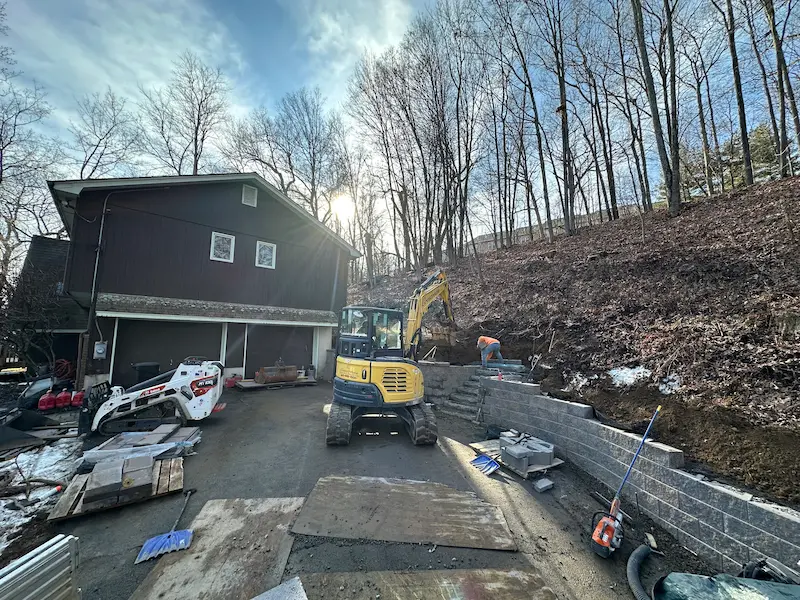
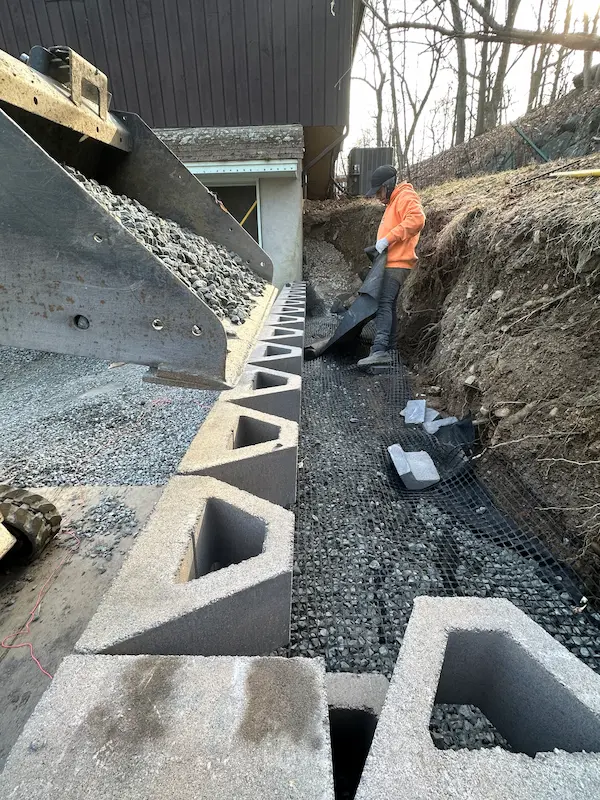
Retaining walls are the foundation of most successful sloped yard designs. They:
Create usable flat areas
Prevent soil erosion
Support patios, walkways, and planting beds
Improve safety and accessibility
Terracing a slope into multiple levels often allows homeowners to add patios, fire pits, seating areas, or lawn sections that would otherwise be impossible.
💡 Important: Wall height directly impacts permitting and engineering requirements in Bergen County.
2. Steps & Stair Systems (Often Required)
As retaining wall height increases, steps become necessary for both safety and usability.
Low walls may require 3–5 steps
Taller walls may require multiple stair sections
Step placement affects drainage, lighting, and layout
Poorly designed stairs are one of the most common mistakes we see on sloped yards.
3. Drainage Solutions for Sloped Properties (Non-Negotiable)
Drainage is the most critical component of sloped yard landscaping.
Effective solutions often include:
French drains
Catch basins
Downspout redirection
Grading corrections
Subsurface drainage behind retaining walls
⚠️ Skipping drainage almost guarantees future failure — especially after heavy Bergen County rainstorms.
4. Patios Designed Specifically for Sloped Yards
Slopes don’t eliminate patios — they just change how patios are built.
Common options include:
Multi-level patios
Raised patios supported by retaining walls
Patios built into terraced landscapes
Proper base preparation, wall support, and drainage are critical to prevent settling or cracking.
5. Plantings That Stabilize Slopes
Plants do more than look good — they hold slopes together.
Effective planting strategies include:
Deep-rooted shrubs
Ground cover to prevent erosion
Privacy trees for screening and visual balance
Native plants that tolerate slope conditions
Planting design should always work with drainage, not against it.
6. Landscape & Step Lighting for Safety and Design
Lighting is often overlooked but extremely important on sloped yards.
Benefits include:
Safer stair navigation at night
Highlighting retaining walls and terraces
Improving curb appeal and resale value
Step lights, path lights, and low-voltage landscape lighting are common solutions.
Permits & Retaining Wall Rules in Bergen County
Permitting rules vary by town, but general guidelines often include:
Walls under ~4 feet may not require engineering
Walls 4–5 feet or higher often require permits
Taller walls typically require engineered drawings
Steps, railings, and drainage may trigger additional review
This is why planning matters before construction begins.
Hidden Costs Homeowners Don’t Expect on Sloped Yard Projects
Sloped yard landscaping almost always involves costs beyond surface materials.
Common hidden expenses include:
Excavation and soil removal
Backfill and base materials
Drainage systems
Wall footings and reinforcement
Additional steps as wall height increases
Lighting and electrical work
Understanding these early prevents budget shock later.
Why 3D Landscape Design Is Essential for Sloped Yards
Sloped yards are difficult to visualize on paper.
That’s why 3D landscape design is especially valuable for these projects.
3D design allows homeowners to:
See elevation changes clearly
Understand wall heights and step counts
Visualize drainage flow
Make changes before construction starts
This reduces mistakes and speeds up approvals.
Planning Sloped Yard Landscaping in Bergen County Towns
This type of landscaping is especially common in towns like Paramus, Ridgewood, Franklin Lakes, Allendale, Oaland, and Wyckoff, where properties often feature elevation changes, mature trees, and older lot layouts.
County-wide planning ensures designs account for:
Local soil conditions
Drainage patterns
Setback limitations
Permit requirements
Final Thoughts: Sloped Yards Can Be a Huge Asset
With proper planning, sloped yards in Bergen County can be transformed into stunning, functional outdoor spaces — not ongoing headaches.
The key is combining:
✔ Retaining walls
✔ Drainage
✔ Steps
✔ Smart planting
✔ Lighting
✔ Proper design
All planned before construction begins.
Click to Visit our Retaining Wall Page to Learn More. See how we plan, design, and maintain outdoor spaces year-round.
Yes. Sloped yards are very common throughout Bergen County and can be transformed using retaining walls, terracing, proper drainage, steps, and strategic planting. The key is designing the yard to work with the natural elevation, not against it.
In most cases, yes. Sloped yards often experience runoff, erosion, or standing water at the base of the slope. Professional drainage solutions in Bergen County, NJ help protect retaining walls, patios, and plantings from long-term damage.
Not always, but many successful sloped yard designs include retaining walls to create usable levels, prevent erosion, and support patios or walkways. Wall height often determines whether permits or engineered drawings are required.
Yes. Many homeowners choose to phase sloped yard projects over time — starting with drainage and retaining walls, then adding patios, plantings, lighting, or privacy features later.
Yes. Patios can be built on sloped yards using multi-level designs, raised patios, or wall-supported bases. Proper excavation, base preparation, and drainage are critical for long-term stability.