Outdoor Living Specialist
Your backyard shouldn’t just be grass and a grill.
In New Jersey — especially across Bergen, Essex, and Passaic County — outdoor living spaces have become true extensions of the home. They’re where families entertain, unwind after work, host holidays, and spend long summer evenings outside.
But designing an outdoor living space in NJ requires more than just picking pavers and adding a fire pit.
Between slopes, drainage, permits, and weather exposure, proper planning makes the difference between a backyard that lasts 5 years… and one that lasts 25+.
Here’s how to design it the right way.
Step 1: Start With How You Want to Use the Space
Before choosing materials or layouts, ask:
Is this mainly for entertaining?
Do you want outdoor dining?
Do you want a quiet retreat?
Is a pool part of the future plan?
Do you want year-round use?
In Bergen County towns like Franklin Lakes or Ridgewood, homeowners often prioritize entertaining — larger patios, outdoor kitchens, covered pergolas, integrated lighting.
In Essex County towns like Montclair or Verona, curb appeal and architectural flow matter more — the outdoor space needs to complement the home’s style.
In Passaic County, especially in Wayne and surrounding areas, slope and drainage often shape the design first.
Function always comes before materials.
Step 2: Evaluate the Property (Especially in NJ)
New Jersey yards are rarely flat and simple.
A proper outdoor living design considers:
Grading and slope
Drainage patterns
Soil conditions
Sun exposure
Privacy
Existing trees
Property setbacks
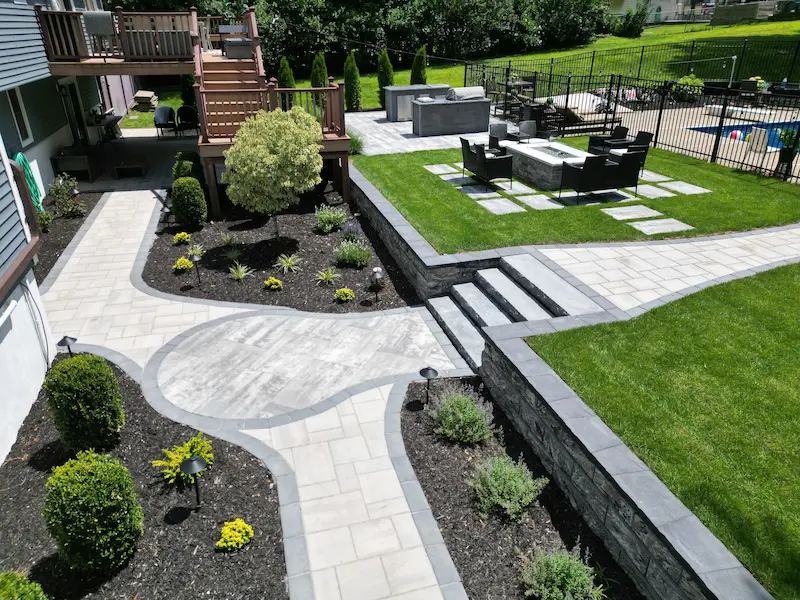
In Passaic County, retaining walls are often required to create usable patio space.
In Bergen County, many luxury properties require elevation adjustments for seamless indoor-outdoor transitions.
Skipping this evaluation leads to:
Water pooling
Patio settling
Wall movement
Foundation issues
This is why professional design — especially with 3D visualization — becomes critical.
Step 3: Build Around a Strong Patio Foundation
The patio is the anchor of your outdoor living space.
Everything connects to it:
Outdoor kitchen
Fire feature
Seating walls
Pergola
Walkways
Material choices in NJ typically include:
Concrete pavers (durable, flexible for freeze/thaw cycles)
Natural stone (luxury aesthetic)
Large-format slabs (modern style)
The key isn’t just the surface — it’s the base.
In NJ’s freeze-thaw climate, proper excavation, compaction, drainage stone, and edge restraint are what determine longevity.
A beautiful patio without the right base will fail.
Step 4: Add Functional Zones
The best outdoor living spaces feel intentional.
Think in “zones”:
Dining Area
Space for table and chairs with clear walking paths.
Lounge Area
Fire pit or fireplace with comfortable seating.
Cooking Zone
Built-in outdoor kitchen, grill island, or pizza oven.
Shade Structure
Pergola, pavilion, or retractable cover.
Transition Zones
Steps, landings, walkways, and lighting.
Layering zones makes the backyard feel like an extension of your home — not just a slab of pavers.
Step 5: Plan for Drainage From the Beginning
This is one of the biggest mistakes homeowners make.
Water management should be designed into the project — not added later.
That includes:
Pitching patios away from the home
Installing channel drains where needed
French drains
Proper backfill behind retaining walls
Downspout extensions
In Passaic County especially, improper drainage can cause major issues due to slope and soil composition.
Drainage isn’t visible — but it protects your investment.
Step 6: Incorporate Lighting for Usability
Lighting transforms outdoor living from daytime use to nighttime enjoyment.
Smart outdoor lighting can include:
Step lighting
Wall cap lights
Under-counter kitchen lighting
Path lights
Uplighting for trees
Integrated patio lighting
Lighting improves:
Safety
Ambiance
Security
Property value
In Bergen County, lighting is often integrated into higher-end outdoor living designs to create resort-style environments.
Step 7: Consider Year-Round Comfort
New Jersey has four seasons.
A great outdoor living space should function beyond summer.
Ways to extend usability:
Gas fire pits or fireplaces
Patio heaters
Covered pergolas or pavilions
Wind screens
Strategic plantings for privacy
Designing for seasonal flexibility increases return on investment.
Step 8: Don’t Forget Softscape
Hardscape creates structure.
Softscape brings life.
Plantings and privacy trees:
Soften retaining walls
Frame patios
Add seasonal color
Provide privacy
Improve drainage absorption
In Essex County especially, landscape character and curb appeal matter. The right plant selection can elevate the entire design.
Step 9: Use 3D Landscape Design Before Building
One of the biggest upgrades in modern landscape design is 3D visualization.
Before construction begins, homeowners can see:
Patio layout
Kitchen placement
Wall height
Lighting effects
Plant positioning
Elevation changes
This eliminates guesswork.
It also prevents costly mid-project changes.
For complex NJ properties — especially sloped yards — 3D design ensures everything works structurally and visually before excavation begins.
Step 10: Understand Permits & Local Requirements
Depending on your project, permits may be required for:
Retaining walls over certain heights
Outdoor kitchens with gas lines
Structural pergolas or pavilions
Pool patios
Electrical work
Each town across Bergen, Essex, and Passaic County has its own requirements.
Ignoring this step can delay projects or create fines later.
Common Outdoor Living Mistakes to Avoid
Making the patio too small
Ignoring drainage
Not planning future phases
Choosing materials based only on price
Skipping lighting
Not considering winter conditions
Failing to design privacy
Outdoor living should be intentional — not pieced together over time.
Final Thoughts
Designing an outdoor living space in NJ isn’t just about aesthetics.
It’s about:
Proper base construction
Drainage planning
Climate durability
Functional layout
Long-term value
When designed correctly, your backyard becomes the most used “room” in your home.
Whether you’re in Bergen County focusing on luxury entertaining, Essex County improving curb appeal, or Passaic County managing slope and drainage — proper planning makes all the difference.
Ready to Design Your Outdoor Living Space?
If you’re planning to upgrade your backyard in Bergen, Essex, or Passaic County, our team at RVG Landscape Design & Build can help you design it the right way — starting with a detailed 3D landscape plan so you can see your space before construction begins.
From custom patios and outdoor kitchens to fire features, lighting, pergolas, and full backyard transformations, we create outdoor living environments built for New Jersey homes.
Explore Our Outdoor Living Services Here
Costs vary based on size, materials, and features. Simple patios may start in the lower five figures, while full outdoor kitchens and multi-zone designs can reach higher investment levels.
Basic patios often don’t require permits, but retaining walls, gas lines, electrical work, and structures usually do. Always check your local municipality.
Yes. It prevents layout mistakes, improves communication, and allows you to visualize your investment before construction begins.